Ask most families what worries them about an elderly parent living alone, and food comes up fast, not because anyone’s dramatic about it, but because appetite and eating habits are often the first quiet sign that something’s changed. Cooking for one feels pointless. Groceries pile up unused. A once-enthusiastic cook starts living on toast.
Good senior nutrition isn’t really a diet question. It’s a quality-of-life question, and it’s one of the more concrete, checkable things a family can look at when weighing up a care setting.
Key takeaways
- Nutrition affects far more than weight in older adults; it’s linked to independence, mood, and resistance to illness, which is why it deserves more attention than “eating enough.”
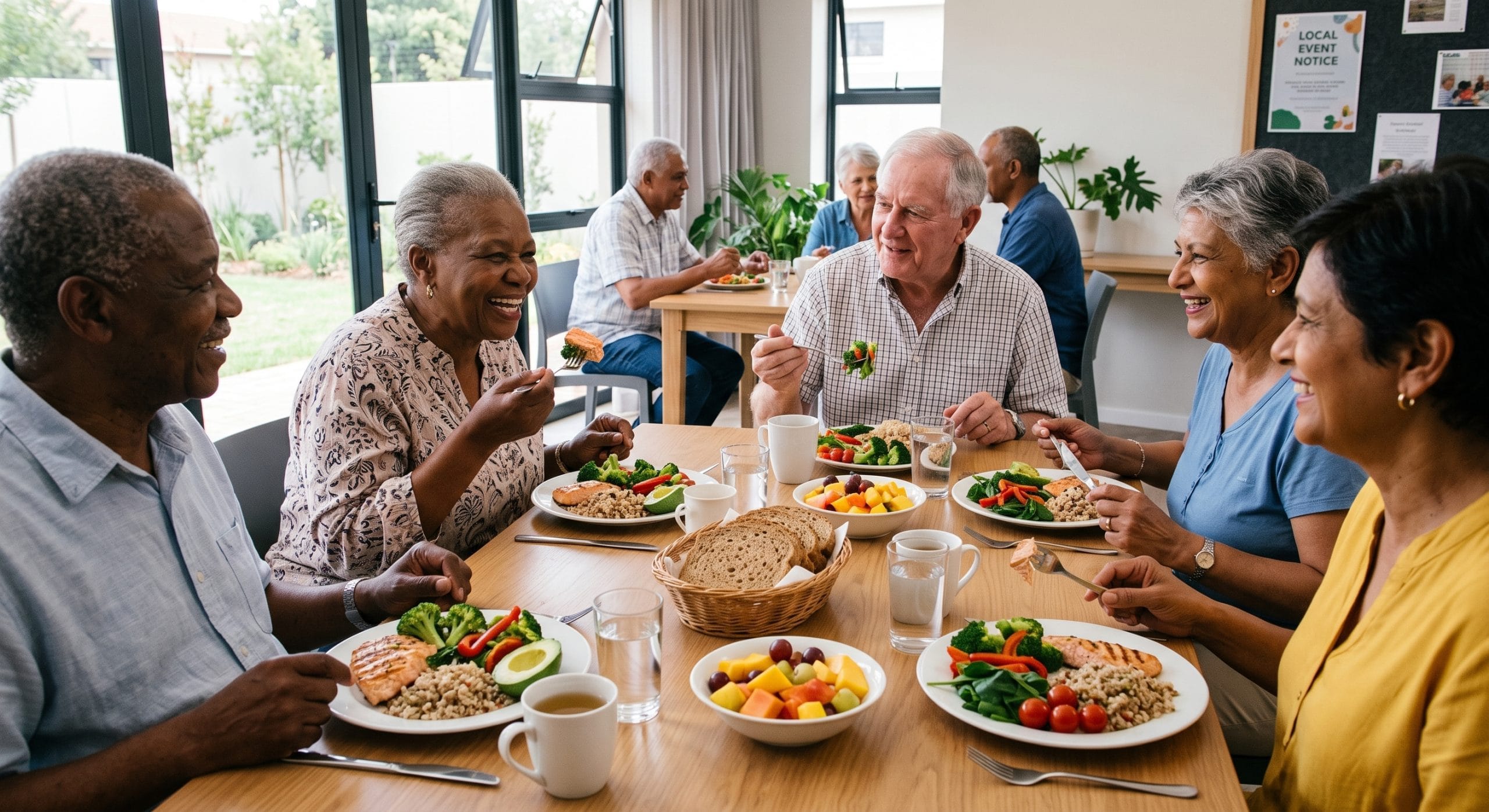
- Nazareth Care serves meals buffet-style in a communal dining setting, deliberately combining nutrition with the social interaction that mealtimes have always provided.
- Eating well and eating together are connected, not separate goals; isolation at mealtimes is one of the quieter risk factors for declining health in older adults.
Why nutrition matters more, and differently, as we age
The nutritional needs of a 75-year-old aren’t the same as those of a 35-year-old, even at the same body weight. Metabolism slows, appetite often decreases, and the body becomes less efficient at absorbing certain nutrients even when intake looks adequate on paper. At the same time, the practical barriers to eating well tend to increase: reduced mobility makes cooking harder, a fixed income makes fresh produce feel like a luxury, and cooking for one person rarely feels worth the effort.
The result is a real risk of malnutrition that isn’t always visible; someone can appear to be eating “fine” while quietly missing the fibre, protein, and micronutrients that support bone density, immune function, and cognitive health. This is one of the reasons nutrition-related decline can accelerate quickly once it starts: the less well someone eats, the less energy and appetite they have, which compounds the problem.
What good senior nutrition actually requires
A few principles come up consistently in how nutrition should be approached for older adults:
- Nutrient density over calorie count. With appetite often reduced, every meal needs to work harder: vegetables, lean protein, and whole grains rather than empty calories.
- Adequate hydration. Thirst signals weaken with age, so older adults are at real risk of low-grade dehydration without realising it, which can affect everything from energy levels to cognitive clarity.
- Consistent meal planning, so nutrition doesn’t depend on daily motivation or energy that may not be there.
- Eating socially rather than alone, which reliably increases how much and how well people eat.
That last point is where the setting someone eats in matters as much as what’s on the plate.
How Nazareth Care approaches dining
At Nazareth Care, meals are served buffet-style in a communal dining setting rather than delivered to residents in isolation. That’s a deliberate choice, not just a logistical one: it means residents choose what and how much they eat, preserving a degree of independence and personal preference that a fixed, pre-plated meal doesn’t allow, while eating alongside other residents rather than alone.
This connects directly to physical health, one of the seven pillars of quality of life Nazareth Care works to uphold across its communities, alongside social connection, mental health, and personal choice. Dining sits right at the intersection of several of those pillars at once: nutrition, autonomy, and social contact, all in the same daily routine.
It’s also worth noting what buffet-style dining avoids: the loss of choice that comes with a fixed, pre-plated menu decided entirely by someone else. For residents who’ve spent a lifetime deciding what and how much they eat, that small element of ongoing control tends to matter more than it might sound on paper; it’s one less part of daily life handed over entirely to someone else’s judgement.
For more general, practical guidance on eating well in later life, including tips on managing appetite changes and working within a budget, our detailed healthy eating guide for seniors is worth reading alongside this piece; it covers the day-to-day “how” in more depth than we have room for here.
Hydration: the quieter risk
Nutrition conversations tend to focus on food, but hydration deserves equal attention. As we age, the body’s thirst signal becomes less reliable, meaning an older adult can be meaningfully dehydrated without ever feeling thirsty. Left unaddressed, this shows up as confusion, fatigue, dizziness, and an increased fall risk- symptoms that are sometimes mistaken for cognitive decline or simply “getting older,” when the actual cause is something as fixable as not drinking enough water.
A structured environment helps here too: regular mealtimes and communal dining naturally build in opportunities to drink fluids consistently throughout the day, rather than relying on an older adult to remember to do so unprompted, one more quiet advantage of a properly run dining routine over eating alone.
The social side of nutrition is not a nice-to-have
It’s tempting to treat “eating together” as a pleasant extra layered on top of the real work of nutrition. In practice, the two are hard to separate. Older adults who eat alone consistently, particularly those living with early cognitive decline or depression, are at higher risk of skipping meals altogether or eating poorly even when food is available. A communal dining environment removes that risk almost by default; there’s structure, company, and a reason to show up at the table three times a day.
This is also where residents with more specific care needs, including those in frail care, benefit from a setting that treats mealtimes as part of overall wellbeing rather than a purely clinical task to be completed.
Frequently asked questions
Can dietary requirements and restrictions be accommodated? Individual health and dietary needs are something to discuss directly with the care team when considering a move, so meal plans can be adapted appropriately for each resident.
Does buffet-style dining work for residents with mobility or cognitive challenges? Support is available for residents who need help serving themselves or navigating the dining room, so the communal format doesn’t come at the cost of the assistance some residents need.
Is good nutrition alone enough to prevent decline in older age? No, nutrition is one part of a broader picture that includes physical activity, social connection, and mental stimulation. It’s an important, controllable factor, but not the only one.
The takeaway
Good senior nutrition isn’t just about ticking off food groups. It’s about preserving independence, encouraging connection, and making mealtimes something to look forward to rather than a chore to get through. If you’d like to see how dining works at Nazareth Care in person, get in touch to arrange a visit.